
Access Antrim County Property Records
Antrim County property records are available through the Register of Deeds in Bellaire and through the county's online BSA search system. You can look up deeds, mortgages, assessment records, and tax information by parcel number, owner name, or property address. The BSA Online Search at antrim.mi.us handles many basic queries from home, including online tax payments and assessment lookups. For certified document copies or older records not yet indexed online, contact the Register of Deeds at 203 E. Cayuga Street in Bellaire or submit a mail request. The office maintains all Antrim County property records from deed transfers to land contracts and plat maps.
Antrim County Property Records Overview
Antrim County Register of Deeds
The Antrim County Register of Deeds is located at 203 E. Cayuga Street in Bellaire, Michigan 49615. The office phone is (231) 533-6683, and the fax is (231) 533-8806. All recorded land documents in Antrim County are stored here, including deeds, mortgages, land contracts, liens, easements, and plat maps.
Antrim County is in the northern Lower Peninsula, a region with many lakes and a mix of seasonal and year-round residential properties. The property records here reflect active lakefront markets alongside farmland and wooded parcels. The Register of Deeds handles all of these uniformly and maintains the official grantor-grantee index as required by MCL 565.28.
| Address | 203 E. Cayuga St., Bellaire, MI 49615 |
|---|---|
| Phone | (231) 533-6683 |
| Fax | (231) 533-8806 |
| Online Search | antrim.mi.us |
| County Seat | Bellaire |
Search Antrim County Property Records Online
The BSA Online Search system, accessible through the Antrim County website, is the primary tool for online property records lookups. You can search by owner name, property address, or parcel number. Assessment records are available through this system, and tax payments can be made online as well. This makes the BSA portal a useful one-stop resource for many common Antrim County property records needs.
For document images and full text of recorded instruments like deeds and mortgages, the online system may have limited access depending on the age and type of document. More recent recordings are often viewable online. Older documents, or those requiring official certified copies, must be requested in person or by mail at the Register of Deeds office in Bellaire.
Mail requests should include the owner's name, property address, or parcel number; the date range or document type you are looking for; and a check or money order for the applicable fees. Copy fees are $1 per page, and certified copies cost $5 per document. Include a self-addressed stamped envelope for faster return of your materials.
Note: Online assessment and tax records are maintained through the BSA system, but full deed and mortgage document images may require an in-person visit or mail request for older filings.
Antrim County Property Records: Document Types
The Antrim County Register of Deeds maintains all documents that affect ownership or encumbrance of real property in the county. Warranty deeds, quitclaim deeds, and special warranty deeds are the most searched records. Each transfers ownership interests and is indexed by the names of the grantor and grantee at the time of recording.
Mortgages and mortgage discharges are also held here. After a loan is repaid, the lender is required by MCL 565.41 to record a discharge. If this step is missed, the lien may remain on the title even after the debt is paid. Checking for open mortgages and verifying that discharges exist is a standard step in any Antrim County property records search related to a purchase or refinance.
Land contracts, construction liens, mechanic's liens, tax liens, and judgment liens are additional document types filed with this office. Easements and right-of-way agreements also appear in the index. Plat maps and surveys are on file and show lot boundaries, subdivision layouts, and public easements. UCC fixture filings, which relate to personal property attached to real estate, are also held here.
Antrim County Recording Fees and Document Standards
Documents submitted to the Antrim County Register of Deeds must comply with Michigan's statewide recording requirements. Under MCL 565.201, the first page of every document must have a 2.5-inch top margin. All other margins must be at least 0.5 inches. Documents must be on white 8.5 by 11 inch paper, at least 20-pound weight, with black ink and at least 10-point font. Names must be printed below signatures so they are easily readable.
Each document must contain a single recordable event. The drafter's name and address must appear on the document as required by MCL 565.201a. Documents that do not meet these standards are still accepted but charged a $25 non-standard document penalty on top of the standard recording fee. To avoid this additional charge, review the formatting requirements before submitting.
The standard recording fee is $30 per document. For each instrument assigned or discharged within a filing, an additional $3 fee applies. Transfer taxes are due at recording: the county rate is $1.10 per $1,000 of property value, and the state rate is $7.50 per $1,000. Both are collected at the time of recording for most deed transfers.
Michigan Property Law Affecting Antrim County Records
Michigan's race-notice recording rule applies throughout Antrim County. Under MCL 565.29, a buyer or lender who records first and had no prior knowledge of a competing claim takes priority. This is why recording promptly after closing matters. A deed that sits unrecorded for even a short time can be vulnerable to a competing claim from another party who records during that window.
The Marketable Record Title Act at MCL 565.101 gives Antrim County property owners a tool to clear historical title defects. After 40 years, most claims against a property are extinguished under this law. Mineral rights claims are cleared after 20 years. For lakefront and rural properties with complex title histories, this statute is often relevant in resolving old encumbrances or competing claims.
The full text of all Michigan recording laws is available at the Michigan Compiled Laws database. For assessment-related questions, the State Tax Commission is the governing body. Antrim County properties are assessed at 50% of true cash value, and taxable value increases are capped under Proposal A until the property is sold.
Additional Resources for Antrim County Property Records
These tools can give you a starting point before you contact the Register of Deeds directly.
For UCC filings at the state level, the Michigan Department of Licensing and Regulatory Affairs handles these separately from county-level fixture filings. Contact LARA at michigan.gov/lara or call 517-322-1144. State-level UCC searches are most relevant for commercial property transactions in Antrim County.
The Michigan Unclaimed Property database is another resource that may help if you are researching an estate or an old property with a complicated ownership history. You can search by name or business name at no cost. The Michigan Treasury website covers property tax programs, homestead exemptions, and assessment appeal procedures statewide.
Michigan LARA for state-level UCC filings related to Antrim County property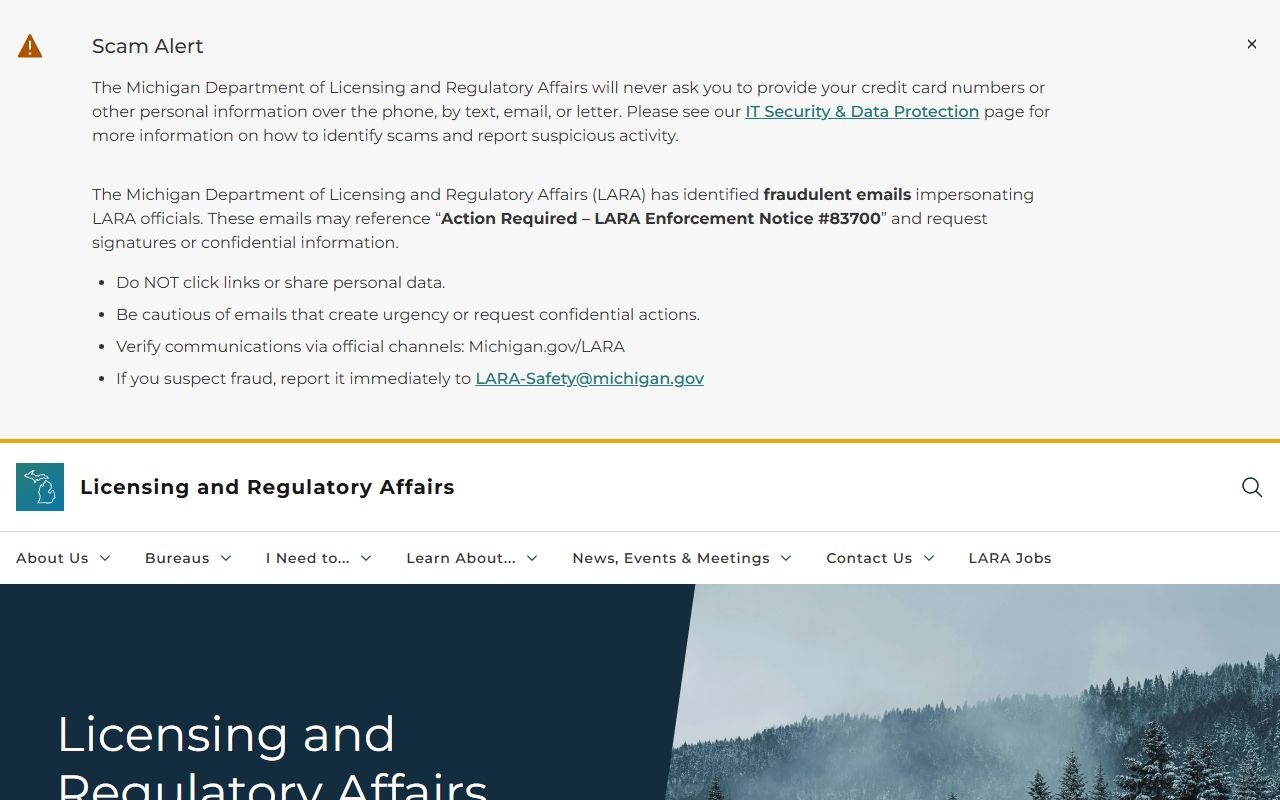
LARA manages state-level UCC filings that may affect commercial real property in Antrim County, separate from the fixture filings held at the county Register of Deeds.
Cities in Antrim County
Antrim County has no cities that meet the population threshold for a dedicated page on this site. Bellaire is the county seat, and communities like Elk Rapids and Mancelona are notable local towns, but none qualify based on population. For property records tied to any address in Antrim County, contact the Register of Deeds at (231) 533-6683 or use the BSA Online Search at antrim.mi.us.
Nearby Counties
Antrim County is bordered by five other Michigan counties. Each handles its own property records through a separate Register of Deeds office.