
Luce County Property Records
Luce County property records are maintained by the Register of Deeds office in Newberry, the county seat in Michigan's Upper Peninsula. The office records and indexes all instruments affecting real property in the county, including deeds, mortgages, liens, easements, and plats. You can search Luce County property records in person at the courthouse, by mail, or through available online tools that index recorded documents by party name and document type.
Luce County Property Records Overview
Luce County Register of Deeds
The Register of Deeds is located at 407 W. Harrie St. in Newberry. Call (906) 293-5521 with questions about recorded documents or recording procedures. The fax number is (906) 293-3415. This office serves as the official keeper of all real property instruments in Luce County, maintaining the grantor-grantee index required under MCL 565.28. All documents presented for recording must meet the formatting standards set out in MCL 565.201.
Luce County is a rural Upper Peninsula county with a relatively small population and a large land area. Much of the land is forest, including portions of the Tahquamenon Falls State Park area and timber holdings. Property transactions here involve a mix of private residential parcels, recreational land, hunting camps, and agricultural tracts. The Register of Deeds records all of these instruments under the same state standards.
How to Search Luce County Property Records
In-person searches at the Newberry courthouse let you work directly with the grantor-grantee index. Staff can help you navigate the index books and locate documents by party name or document type. For older records, you may find that pre-digital index books are the only option.
Mail requests work well for straightforward searches. Write to the Register of Deeds with the names of the parties, the approximate recording date, and a description of the document type you need. Include payment for the search fee and copy costs. The office will search the index and send copies along with any balance due. Getting a self-addressed stamped envelope helps speed up the return.
Michigan is a race-notice state under MCL 565.29. This means that a buyer who records first and has no notice of a prior unrecorded interest generally prevails. This principle makes the recorded index the definitive source for establishing ownership priority in Luce County. Buyers, lenders, and researchers all rely on it.
Luce County is a small rural county. If you need a comprehensive title search covering multiple transactions over many decades, consider working with a professional title abstractor who is familiar with Upper Peninsula records.
Types of Documents Recorded
The Register of Deeds accepts and records a wide range of instruments. Warranty deeds and quitclaim deeds are the most common, used to transfer ownership of real property. Mortgages and mortgage discharges record lending and payoff activity. Land contracts, which are common in rural Michigan, are also recorded here.
Liens come in several forms. Mechanic's liens protect contractors and suppliers. Federal and state tax liens attach to property when taxes go unpaid. Judgment liens can also be recorded against real property. Each of these types is indexed in the grantor-grantee system so that a title search will surface them during due diligence.
Easements define rights of way and access across parcels. In a county with significant recreational land and timber activity, easements for access roads, utility lines, and recreational use appear frequently. Plats show the subdivision of land into lots and blocks and must be recorded before lots can be conveyed separately. Survey documents and other miscellaneous instruments round out the record set.
Recording Requirements and Transfer Tax
All documents submitted for recording in Luce County must meet the formatting standards in MCL 565.201. The first page must have a 2.5-inch top margin. All other margins must be at least 0.5 inches. Each document should record a single instrument. Font must be legible and print must be clear enough to produce a quality image.
The flat recording fee under MCL 600.2567 is $30 per document. Additional assigned or discharged instruments within the same document add $3 each. These fees apply uniformly across Michigan.
Conveyances of real property trigger transfer taxes. The county transfer tax is $1.10 per $1,000 of the sale price. The state transfer tax is $7.50 per $1,000. The transfer tax affidavit must accompany the deed at recording. Some transfers are exempt, including transfers between family members and those involving court-ordered conveyances.
Michigan's Marketable Record Title Act (MCL 565.101) provides that a 40-year chain of record title generally clears prior defects and encumbrances. This rule simplifies title searches for older properties where historical gaps might otherwise cloud ownership.
Property Tax and Assessment Records
Property tax and assessment records in Luce County are kept separately from deed records. The county equalization office maintains assessed values and taxable values. Under Michigan's Proposal A, taxable value increases are capped at 5% or the rate of inflation each year, whichever is less. On a sale, the taxable value uncaps and resets to the state equalized value (SEV), which is 50% of the property's true cash value as determined by the assessor.
The Michigan Department of Treasury oversees property tax administration statewide, sets assessment standards, and handles appeals at the state level. The State Tax Commission handles assessment review and compliance. Local township and city assessors set individual parcel values. These assessment records are public and can help you understand recent sale history and the tax implications of a property purchase in Luce County.
The Michigan Unclaimed Property portal is a separate resource that lets you search for unclaimed funds that may be linked to a property address, a previous owner, or an old escrow account. It's worth a quick check during property research.
Michigan Unclaimed Property and Land Research Tools
The Michigan Treasury's unclaimed property portal is a free public tool that allows you to check for unclaimed funds linked to names or addresses across the state.
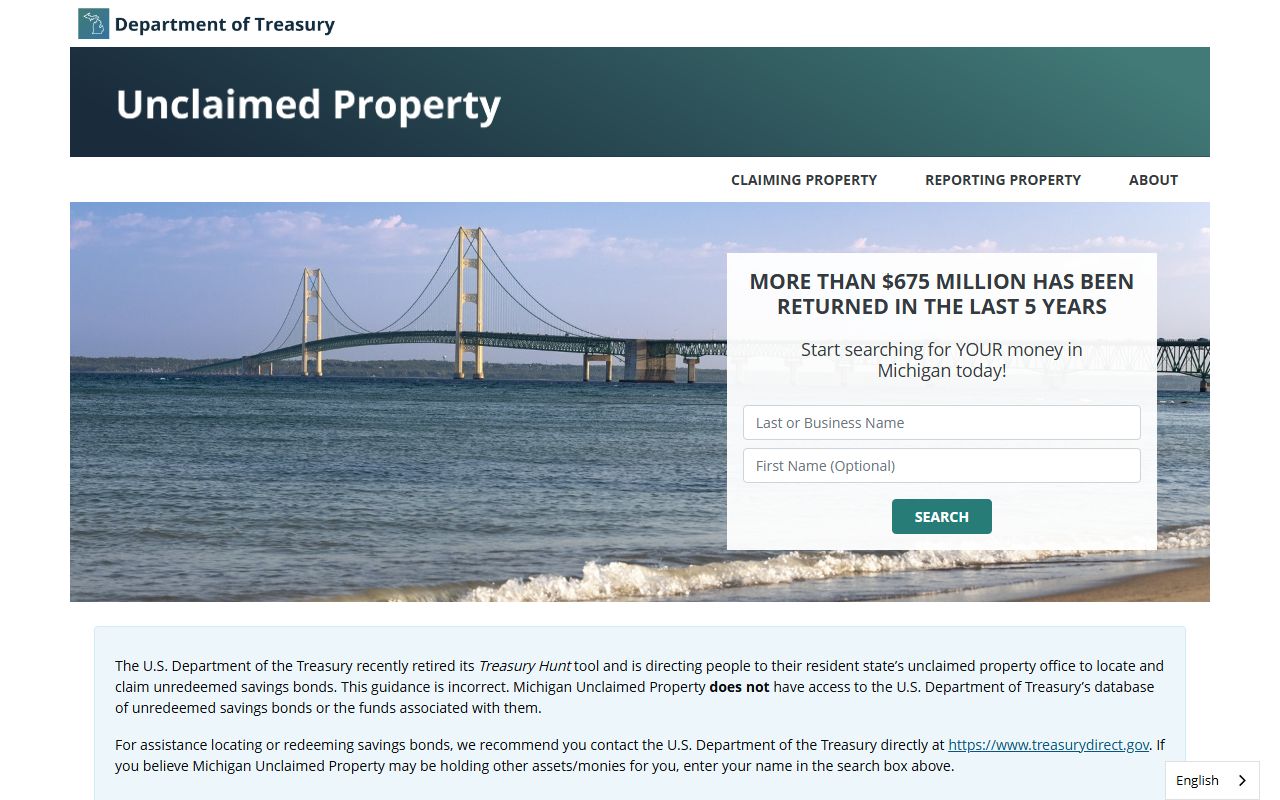
Searching by prior owner names from Luce County deed records can turn up unclaimed funds from old escrow accounts, utility deposits, or insurance proceeds that were never collected.
The Michigan Compiled Laws database through Justia gives free access to the full text of state statutes, including all the recording and property laws that govern Luce County deed transactions. If you need to verify a legal requirement or read the exact text of a statute before recording a document, this is the right resource.
Cities in Luce County
Luce County has no cities that meet the population threshold for individual city pages. Newberry is the county seat and largest community. Property records for all areas of Luce County are filed with the Register of Deeds in Newberry regardless of which village or township the property sits in.
Nearby Counties
Luce County borders several other Upper Peninsula counties. Each has its own Register of Deeds office handling property records for that county.