
Access Gratiot County Property Records
Gratiot County property records are filed and managed by the Register of Deeds in Ithaca, the county seat. The office is responsible for recording all instruments affecting real estate ownership in the county, including deeds, mortgages, land contracts, liens, and easements. Gratiot County sits in mid-Michigan and has a predominantly agricultural landscape with small cities and townships. You can search Gratiot County property records in person at the courthouse or request certified copies by mail from the Register of Deeds office.
Gratiot County Property Records Overview
Gratiot County Register of Deeds Office
The Register of Deeds office is at 214 E. Center St., Ithaca, MI 48847. Reach the office at (989) 875-5215 by phone or (989) 875-5219 by fax. Staff record, index, and store all land instruments filed in Gratiot County. The office is the starting point for any deed search, title search, or mortgage lookup in the county.
| Office | Gratiot County Register of Deeds |
|---|---|
| Address | 214 E. Center St., Ithaca, MI 48847 |
| Phone | (989) 875-5215 |
| Fax | (989) 875-5219 |
The office maintains a grantor-grantee index as required by MCL 565.28. You can search by the name of the transferring party (grantor) or the receiving party (grantee) to find any recorded instrument. For rural farm parcels, the index often shows a long chain of family transfers going back many decades.
What Documents Are Recorded Here
Warranty deeds and quitclaim deeds are the most common documents recorded in Gratiot County, used to transfer residential, agricultural, and commercial real estate. Mortgages, assignments of mortgage, and discharge of mortgage documents are filed when properties are financed or refinanced. Land contracts, a common form of seller financing in Michigan, are also part of the regular recording volume here. Plat documents for any subdivisions in the county are on file as well.
Liens of various types also appear in the index. Federal and state tax liens, mechanic's liens, and other encumbrances are recorded to put the public on notice. If you are doing a title search, checking for all types of liens is an important part of the process. The grantor-grantee index covers all of these instrument types, so a name search should capture any recorded claim against a party's property.
Michigan is a race-notice state under MCL 565.29. The first party to record without knowledge of a prior interest wins. This makes recording as soon as possible after a closing the right move for any buyer.
Recording Fees and Document Requirements
Michigan has a flat $30 recording fee per document, established by MCL 600.2567 and in effect since October 1, 2016. For documents that assign or discharge additional instruments, a $3 add-on applies for each extra reference beyond the first.
Documents must meet the standards set by MCL 565.201: 2.5-inch top margin on the first page, 0.5-inch margins elsewhere, white paper, black ink, and minimum 10-point font. A transfer tax is due at recording for any arm's-length sale. The county transfer tax is $1.10 per $1,000 of the purchase price. The state transfer tax adds $7.50 per $1,000. Both are paid to the Register of Deeds when the deed is submitted.
Property Assessment Basics
All real property in Gratiot County is assessed at 50% of true cash value each year. This is the state equalized value (SEV). The taxable value of a property, which is what your tax bill is based on, can increase by no more than 5% per year or the rate of inflation under Proposal A. When a property sells, the taxable value resets (or uncaps) to the SEV for the following year. For buyers purchasing at a price significantly above the prior assessed value, this can mean a substantial tax increase in the first year of ownership.
Gratiot County's land is largely agricultural, and farm parcels may qualify for special assessment programs that affect taxable value. Local township assessors handle the year-to-year assessment for each parcel. Disputes about assessments go first to the local board of review, then to the Michigan Tax Tribunal if unresolved. The county equalization office oversees assessment consistency across all townships in the county.
Marketable Title and the 40-Year Rule
Under Michigan's Marketable Record Title Act (MCL 565.101), a 40-year unbroken chain of record title is generally enough to establish marketable title and cut off most earlier defects. Title examiners doing work in Gratiot County use the grantor-grantee index to trace each recorded transfer back at least 40 years from the current owner. Once a clean 40-year chain is established, title insurance underwriters can typically insure around earlier issues without requiring a full historical search.
The screenshot below is from the Michigan Compiled Laws site, which provides the full text of all property-related statutes including the Marketable Record Title Act and recording requirements.
The Michigan Compiled Laws site at Justia provides free public access to all Michigan statutes relevant to property recording and title.
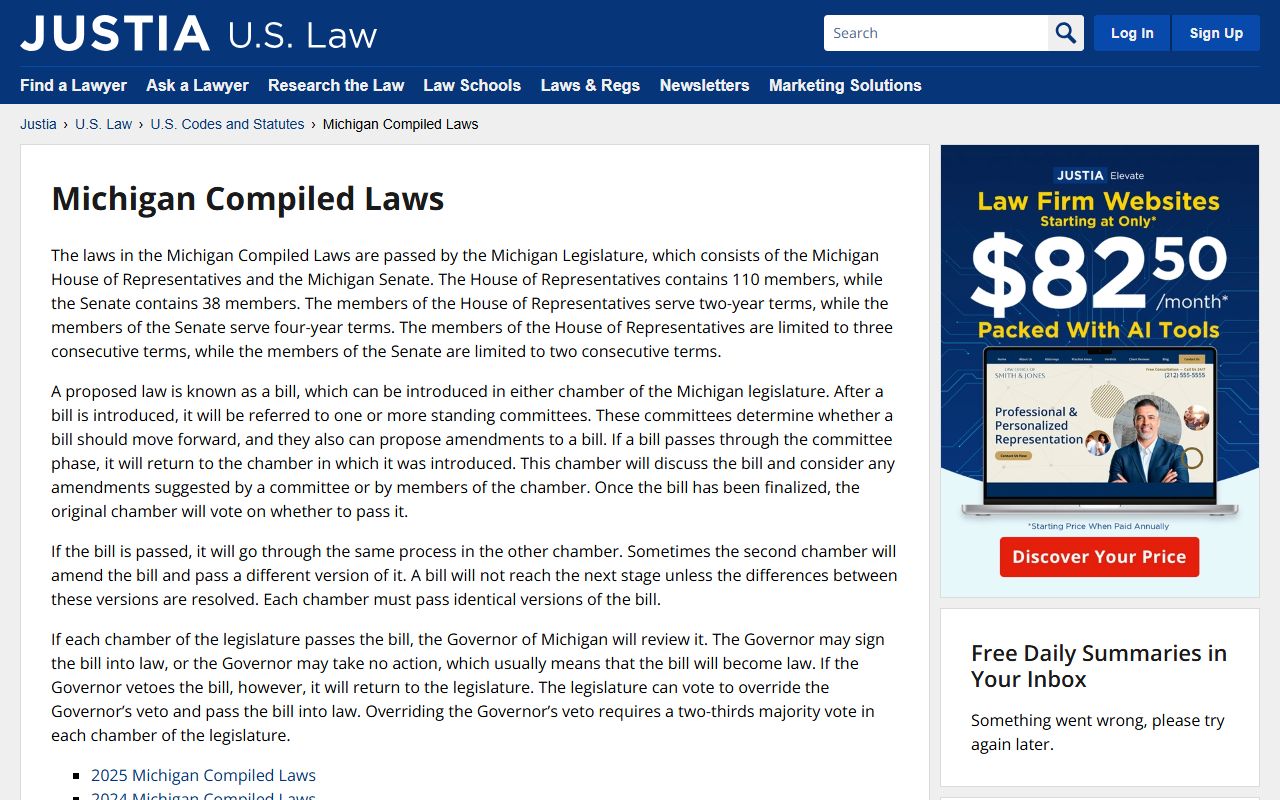
You can look up any MCL section cited here to read the full statutory text, including fee schedules and document formatting requirements.
Additional Resources for Gratiot County Property Research
For UCC filings that may affect commercial real estate or secured party interests, search through Michigan LARA at 517-322-1144. Unclaimed property connected to real estate escrow accounts or title refunds can be found through Michigan's Unclaimed Property portal.
Cities in Gratiot County
No cities in Gratiot County exceed the 100,000-population threshold. Ithaca is the county seat. Alma is the largest city in the county by population. All property records for the county are maintained at the Register of Deeds in Ithaca.
Nearby Counties
Gratiot County is surrounded by mid-Michigan counties. Each has its own Register of Deeds and separate property records systems.