
Clinton County Property Records
Clinton County property records are maintained by the Register of Deeds office in St. Johns. The office records all instruments affecting real property in the county, including deeds, mortgages, easements, plats, and liens. Property tax records are available through BS&A Online, which integrates county assessment and tax data into a searchable public interface. Clinton County is a mid-Michigan county with a mix of agricultural land and suburban properties located near Lansing. You can search Clinton County property records in person, by mail, or through the county's online tools.
Clinton County Property Records Overview
Clinton County Register of Deeds
The Register of Deeds office is at 100 E. State St. in St. Johns. The main phone number is (989) 224-5140. The fax is (989) 224-5149. This is where all Clinton County land instruments are recorded and indexed. The office maintains the grantor-grantee index under MCL 565.28, which covers all recorded instruments and is open to public search.
St. Johns is a smaller county seat, and the Register of Deeds office reflects the county's size. Staff are generally available to assist visitors with index searches and copy requests. For complex research or questions about document interpretation, a title professional or real estate attorney in the area is the appropriate resource.
Clinton County's proximity to Lansing has brought suburban growth into many of its townships over the past few decades. The property record volume has grown with this development, and the index now covers a wide range of residential, agricultural, and commercial instruments.
Searching Clinton County Property Records
Property tax records for Clinton County are available through BS&A Online. This system lets you search by parcel number, owner name, or address to view assessment data, tax history, and ownership information. It draws from county equalization data rather than the Register of Deeds deed index, so the two systems complement each other. BS&A Online is a good starting point before pulling deed records.
The Register of Deeds office provides access to the deed index in person at the St. Johns courthouse. You can search by grantor or grantee name within a date range and request copies of any document you find. Copies cost $1 per page. Certified copies are $5 per document.
Mail requests are accepted. Write to the office with party names, approximate recording dates, document types, and a check for the fees. Allow time for processing. The office will search the index and mail back what it finds.
It gives you assessment values, ownership names, and parcel maps in a single interface.
Note: BS&A Online covers property tax data for Clinton County, but the Register of Deeds deed index is the authoritative source for ownership history and recorded instruments. Use both for a complete picture.
Recording Documents in Clinton County
Every document recorded in Clinton County must meet the standards set by MCL 565.201. Documents must be on 8.5" x 11" white paper of at least 20 lb weight. Black ink is required throughout. The first page must have a 2.5-inch top margin. All other margins must be at least 0.5 inches. Font size must be 10 points or larger. Printed names below each signature are required. Only one recordable event per document is allowed.
MCL 565.201a requires the drafter's name and address on every recorded document. This applies to everyone from attorneys and title companies to private individuals preparing their own instruments. The office will return documents that are missing this information.
The standard recording fee is $30. Additional assigned or discharged instruments cost $3 each. Documents that fail the formatting standards face a $25 non-standard penalty. Copies are $1 per page. Certified copies are $5. Transfer taxes of $1.10 per $1,000 (county) and $7.50 per $1,000 (state) are collected at the time of recording for deed transactions.
Clinton County also records plats for new subdivisions. Plat approval involves the county plat board and must meet specific technical standards. Recorded plats become part of the permanent record and can be accessed through the Register of Deeds along with other instruments.
Property Law Basics for Clinton County
Michigan's race-notice recording rule under MCL 565.29 gives priority to the first party who records a deed or other instrument without prior notice of a competing claim. For buyers in Clinton County's active suburban market near Lansing, recording promptly after closing is essential. Any delay creates risk that a later instrument could be recorded first and take priority.
The Marketable Record Title Act at MCL 565.101 extinguishes most title defects older than 40 years. Mineral rights defects clear after 20 years. Clinton County has a significant amount of agricultural land with older farm deeds, easements, and drainage rights that can cloud title. The act helps resolve many of these older issues without litigation, but a title insurance company should evaluate each situation specifically before writing a policy.
Michigan assessments run at 50% of true cash value. Proposal A limits taxable value growth to the lesser of inflation or 5% per year. When property sells, taxable value resets to the assessed value. In Clinton County, where suburban growth has pushed values up in many townships, the gap between taxable and assessed value can be significant on properties held by long-term owners. New buyers should budget for higher taxes after purchase.
The Michigan Treasury portal provides statewide resources including guidance on property tax programs that apply in Clinton County.
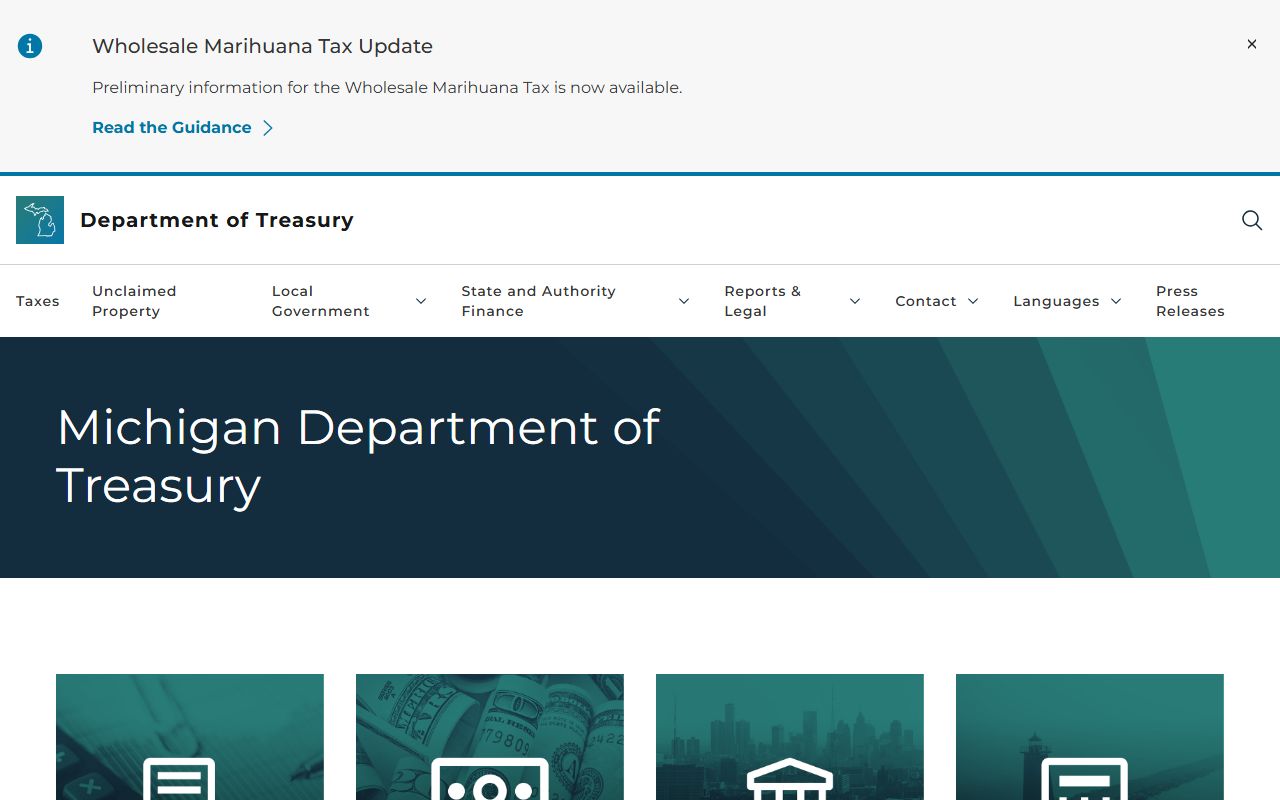
Homestead exemptions and other programs administered by the Treasury can reduce the tax burden on owner-occupied properties in Clinton County.
Clinton County Property Taxes
Property taxes in Clinton County are collected by local township and city treasurers. After the local collection period, delinquent taxes move to the county treasurer. The county equalization department works with local assessors across Clinton County's townships to maintain the 50% true cash value standard required by state law.
The Michigan State Tax Commission oversees equalization practices statewide and provides guidance on assessment methodology. Property owners who disagree with their assessment can appeal to the local board of review each spring. If unresolved, the appeal moves to the Michigan Tax Tribunal.
Tax status for a specific parcel is best verified by contacting the local township treasurer or checking BS&A Online for Clinton County. The Register of Deeds holds formally recorded tax liens, but not all delinquent tax situations result in a lien that appears in the deed index. Always check both sources before closing on a property purchase in Clinton County.
Note: Clinton County's agricultural parcels may qualify for PA 116 agricultural agreements or other farmland preservation programs that affect taxable value and future development options for the property.
Other Clinton County Property Record Sources
The Clinton County circuit court holds records for foreclosure cases and civil judgment liens. A properly filed and docketed judgment creates a lien against all real property the debtor owns in the county. A complete title search should cover circuit court records in addition to the Register of Deeds index.
Probate court handles estate proceedings that often involve real property transfers. Deeds recorded as part of a probate are indexed at the Register of Deeds, but the underlying estate file is at the probate court. Both offices need to be checked for a full ownership history.
For UCC fixture filings tied to specific Clinton County parcels, the Register of Deeds is the correct office. General statewide UCC filings not tied to specific real estate go through Michigan LARA at 517-322-1144. The Michigan Department of Treasury handles state tax programs and exemptions. Unclaimed funds can be searched through Michigan Unclaimed Property at 517-636-5320. The full text of Michigan statutes governing property recording is available at Justia's Michigan code.
Cities in Clinton County
No cities in Clinton County meet the population threshold for a dedicated city page on this site. St. Johns serves as the county seat and is the largest city in the county.
Nearby Counties
Clinton County shares borders with five other mid-Michigan counties. Each has its own Register of Deeds with separate property records.