
Find Eaton County Property Records
Eaton County property records are maintained by the Register of Deeds office in Charlotte, the county seat. This mid-Michigan county sits just west of Lansing and has seen suburban growth alongside its agricultural base. The Register of Deeds records all instruments affecting real property in Eaton County, including deeds, mortgages, liens, plats, and easements. You can search and access Eaton County property records online through the county's official portal, in person at the Charlotte office, or by submitting a formal FOIA request or mail inquiry.
Eaton County Property Records Overview
Eaton County Register of Deeds Office
The Register of Deeds is at 1045 Independence Blvd. in Charlotte. The main phone is (517) 543-7500 and the fax is (517) 543-2404. The Clerk's office, which handles some related functions, can be reached at (517) 543-2426. The Register of Deeds maintains the grantor-grantee index under MCL 565.28 and is the official keeper of all property records in Eaton County.
Eaton County borders Ingham County to the east, and the suburban corridor connecting Charlotte to Lansing has grown significantly. The county's property records reflect this mix: older farm deeds from agricultural townships alongside more recent residential subdivision plats in the townships closest to Lansing. The Register of Deeds handles all of these under the same Michigan recording standards.
Searching Eaton County Property Records
The Eaton County Register of Deeds website provides online access to property records and tax information. You can search the deed index by party name or document type and view images for many instruments. The county also integrates with Michigan Courts Case Search for court records that may affect title, such as foreclosure cases and judgment liens.
In-person searches at the Charlotte courthouse are available during regular business hours. The public index terminals let you search the grantor-grantee index. Staff can assist with locating documents and making copies. Certified copies can be obtained directly at the counter during your visit.
Mail requests work as well. Send the party names, document type, approximate recording date, and payment for the fees. The office will search and mail back the copies. For FOIA requests involving records beyond the standard property index, follow the county's FOIA process: identify the records you need, complete the county FOIA form, and submit it to the FOIA Coordinator. The office has 5 business days to respond, with a possible 10-day extension. Applicable fees apply.
Note: For Eaton County court records that affect title, such as foreclosures or judgment liens, use the Michigan Courts Case Search system in addition to the Register of Deeds index for a complete picture of any encumbrances.
Recording Documents in Eaton County
Every document submitted for recording in Eaton County must meet the standards set by MCL 565.201. These standards require 8.5" x 11" white paper of at least 20 lb weight, black ink throughout, a 2.5-inch top margin on the first page, 0.5-inch margins on all other edges, font size of 10 points or larger, printed names beneath every signature, and only one recordable event per document. Documents that fail these requirements face a $25 non-standard penalty.
MCL 565.201a requires the drafter's name and address on every recorded document. If this is missing, the office returns the document without recording it. Double-check before submitting.
Standard recording fees are $30 per document. Additional assigned or discharged instruments cost $3 each. Copies are $1 per page. Certified copies cost $5. Transfer taxes are $1.10 per $1,000 of the sale price (county) plus $7.50 per $1,000 (state), collected at recording for most deed transactions.
Eaton County also records subdivision plats. New plats must go through the county plat board and meet the technical requirements of Michigan's platting statutes before the Register of Deeds can accept them. Plat approval can take several months for complex subdivisions. Once approved and recorded, the plat becomes the official legal description for all lots within the development.
Eaton County Property Law and Recording Priorities
Michigan operates as a race-notice recording state under MCL 565.29. The first party to record a deed or other instrument, without prior notice of a competing claim, wins any priority dispute. Eaton County buyers should record immediately after closing. Any delay creates risk.
The Marketable Record Title Act at MCL 565.101 can clear old title defects on Eaton County parcels. After 40 years, most land title defects are extinguished by operation of law. Mineral rights defects clear after 20 years. Eaton County has older agricultural properties where easements and drainage rights from the early 20th century may cloud title. The act often resolves these issues, but a title attorney should evaluate each case before relying on the act to clear a defect.
Michigan assessments run at 50% of true cash value. Proposal A limits annual taxable value increases to the lesser of inflation or 5% until a property sale. At sale, taxable value resets to the full assessed value. In Eaton County townships where values have risen due to suburban growth, new buyers can face a significant jump in property taxes compared to what the prior owner was paying.
The Michigan State Tax Commission portal covers Eaton County property tax rules, equalization standards, and assessment guidance.
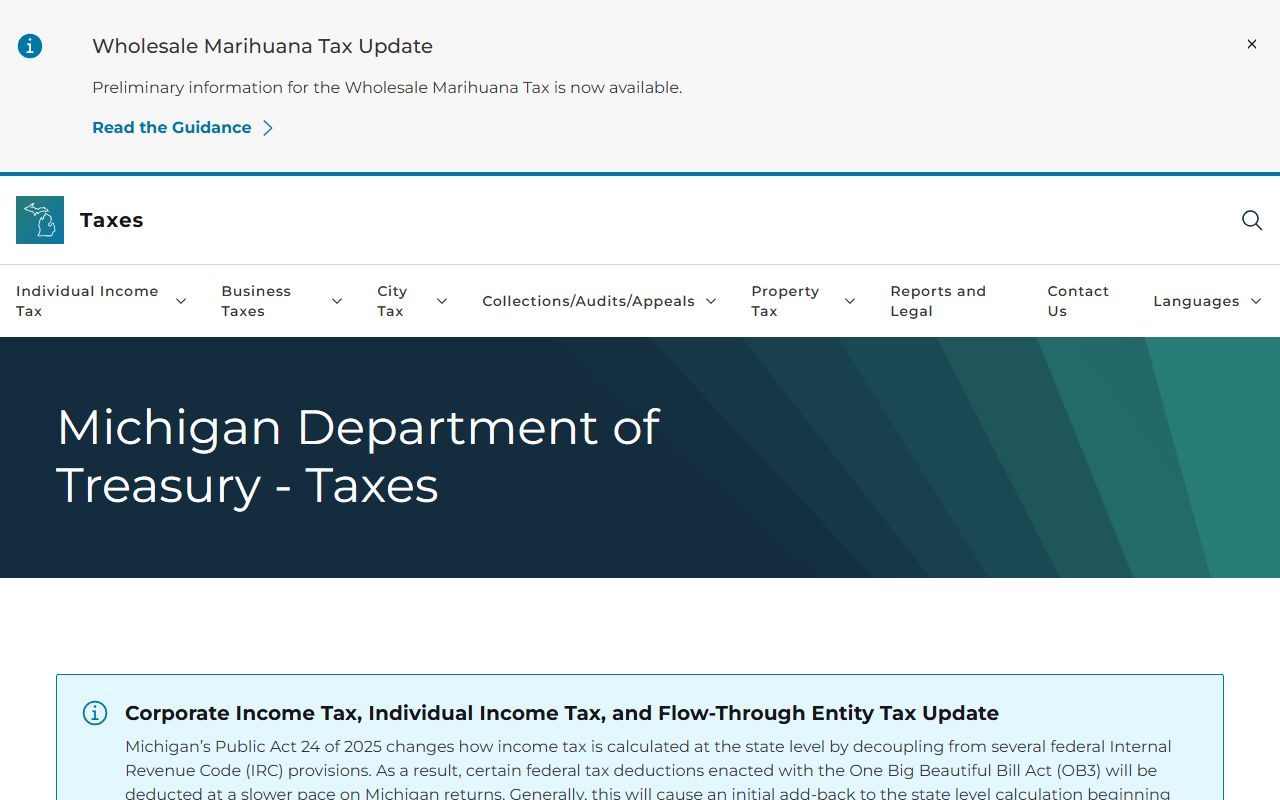
The Tax Commission site explains the Proposal A cap, assessment methodology, and the appeal process for Eaton County property owners.
Eaton County Property Taxes and Assessments
Local township and city treasurers collect current-year property taxes in Eaton County. Delinquent taxes move to the county treasurer after the local collection period. The Eaton County equalization department ensures that all local assessments maintain the 50% true cash value standard. Annual equalization studies compare assessed values to recent market sales across all of the county's townships and municipalities.
Eaton County has a wide mix of property types. Agricultural parcels in the western townships, residential subdivisions near Lansing, and commercial strips along major roads all have different assessment approaches. Agricultural parcels may qualify for PA 116 agreements that reduce taxable value in exchange for a commitment to keep the land in farm use. Buyers of agricultural land should check for these agreements before purchase.
The Michigan State Tax Commission sets the rules that local assessors follow and audits county equalization annually. Property owners who disagree with their assessment appeal first to the local board of review in the spring. Unresolved appeals proceed to the Michigan Tax Tribunal. The Tax Commission also administers the Principal Residence Exemption, which reduces millage for owner-occupied primary residences.
The Michigan Department of Treasury manages the Principal Residence Exemption filing process and handles questions about personal property tax, transfer taxes, and other state-level property tax matters that affect Eaton County parcels.
Note: Eaton County agricultural properties enrolled in PA 116 agreements carry a recapture penalty if the land is converted to non-agricultural use before the agreement term ends. Buyers should review any existing PA 116 agreements before closing.
Additional Eaton County Property Record Sources
The Eaton County circuit court holds records for foreclosure actions and civil judgment liens. The Michigan Courts Case Search system provides access to case information for circuit court proceedings that may affect Eaton County real property. Foreclosure proceedings and judgment liens must be checked during any title search.
Probate court records matter when property passes through an estate. Deeds recorded as part of a probate proceeding appear in the Register of Deeds index, but the underlying estate file is at the probate court. Both offices need to be searched for a complete ownership history on any parcel that transferred through an estate.
UCC fixture filings tied to specific Eaton County parcels are recorded at the Register of Deeds. Statewide UCC filings not tied to specific real property go through Michigan LARA at 517-322-1144. Unclaimed funds from former property owners can be found at Michigan Unclaimed Property at 517-636-5320. The full text of Michigan statutes is available at Justia's Michigan code repository.
Cities in Eaton County
No cities in Eaton County meet the population threshold for a dedicated city page on this site. Charlotte serves as the county seat. Grand Ledge is another notable city in the county.
Nearby Counties
Eaton County borders five other mid-Michigan counties. Each has its own Register of Deeds with separate land records.